
The AISC Shock Test: Why Low-Cost Miners Matter Most When Oil Drives Inflation Higher
How oil-driven inflation, rising diesel costs, and AISC pressure could separate low-cost gold and silver miners from higher-risk mining stocks in 2026.

The AISC Shock Test: Why Low-Cost Miners Matter Most When Oil Drives Inflation Higher
Inflation is no longer abstract. It is the cost of filling a tank, paying a power bill, moving freight, hiring labour, renewing insurance, financing debt, or simply keeping a business open.
Mining companies face the same pressure, only at industrial scale.
Every litre of diesel, every truck tyre, every contractor invoice, every shipment of reagents, every power contract, every spare part, and every financing decision can move the cost base higher. For a miner, those pressures eventually appear in AISC, capex, dilution, and NAV.
That is why this cycle demands a harder question.
It is not enough to ask which companies have the most ounces. It is not enough to ask which companies offer the most leverage to gold, silver, copper, or critical minerals. In an oil-driven inflation cycle, the better question is simpler and more important:
Which companies have a low enough AISC to survive the shock?
Low-cost miners are not immune to inflation. No miner is. But they begin with a larger margin buffer. That buffer becomes valuable when diesel, freight, power, labour, consumables, contractors, sustaining capital, and financing costs all move higher at the same time.
A high-AISC producer has little room for error. A low-AISC producer can absorb more pressure before margins are impaired. A low-cost developer may offer major upside, but only if its estimated AISC survives updated capex, financing, construction, and operating assumptions.
This is the logic behind the AISC Shock Test. It asks which companies still make money when everything else costs more.
OF 8.2 already makes this central to valuation. The framework requires AISC determination, NAV Ratio analysis, peer comparison, asset-level risk adjustment, and sensitivity testing around AISC movement, including whether a ±10% AISC change materially moves the NAV Ratio.
That sensitivity now belongs at the centre of the investment discussion.
Oil is moving from macro risk to mine-level risk
Oil matters because it does not enter a mine model once. It enters repeatedly.
Diesel affects haul trucks, generators, drill rigs, underground fleets, site vehicles, camp logistics, and freight. Higher oil also feeds into explosives, reagents, lubricants, tyres, grinding media, shipping, contractor rates, aviation, construction, and power markets. An oil shock can lift operating costs, sustaining capital, initial capex, working capital, and financing needs at the same time.
The macro backdrop is already pointing in that direction. The World Bank’s April 2026 Commodity Markets Outlook forecast energy prices to rise 24% in 2026, with overall commodity prices forecast to rise 16%, driven by the Middle East war, energy disruption, fertilizer prices, and record prices for several key metals. (World Bank)
The IEA’s May 2026 Oil Market Report said global oil supply declined by a further 1.8 million barrels per day in April 2026, taking total losses since February 2026 to 12.8 million barrels per day. It also reported that Gulf-country output affected by the Strait of Hormuz closure was 14.4 million barrels per day below pre-war levels. (IEA)
Diesel is already showing the pressure. U.S. diesel was US$5.523 per gallon for the week ended 25 May 2026, according to FRED data sourced from the U.S. Energy Information Administration. (FRED)
For mining investors, the conclusion is straightforward. If oil remains volatile, the market will increasingly separate companies by cost structure. The winners will not simply be the companies with the most ounces. They will be the companies whose ounces still generate margin after diesel, power, freight, labour, consumables, contractors, sustaining capex, and financing costs rise.
Low AISC is not the whole story, but it is the first defence
AISC is not a perfect metric. It can vary by company, accounting method, sustaining-capex cycle, by-product credits, mine life, and reporting quality.
But in an inflationary cycle, it is one of the best places to start.
A miner with low AISC has more room to absorb cost pressure. A miner with high AISC depends more heavily on the metal price rising faster than the cost base. That can still work in a strong gold or silver market, but it is a more fragile setup.
The distinction is especially important between producers and developers. Reported AISC is based on operating reality. Estimated AISC is based on a study, model, or peer assumption. A low estimated AISC can point to a future margin leader, but it can also create false comfort if capex, construction costs, financing terms, or ramp-up assumptions are stale.
That is why the lowest-AISC names need to be read carefully. A reported low-cost producer has a stronger evidentiary base. A low-cost developer may offer more upside, but it also requires a larger margin of safety.
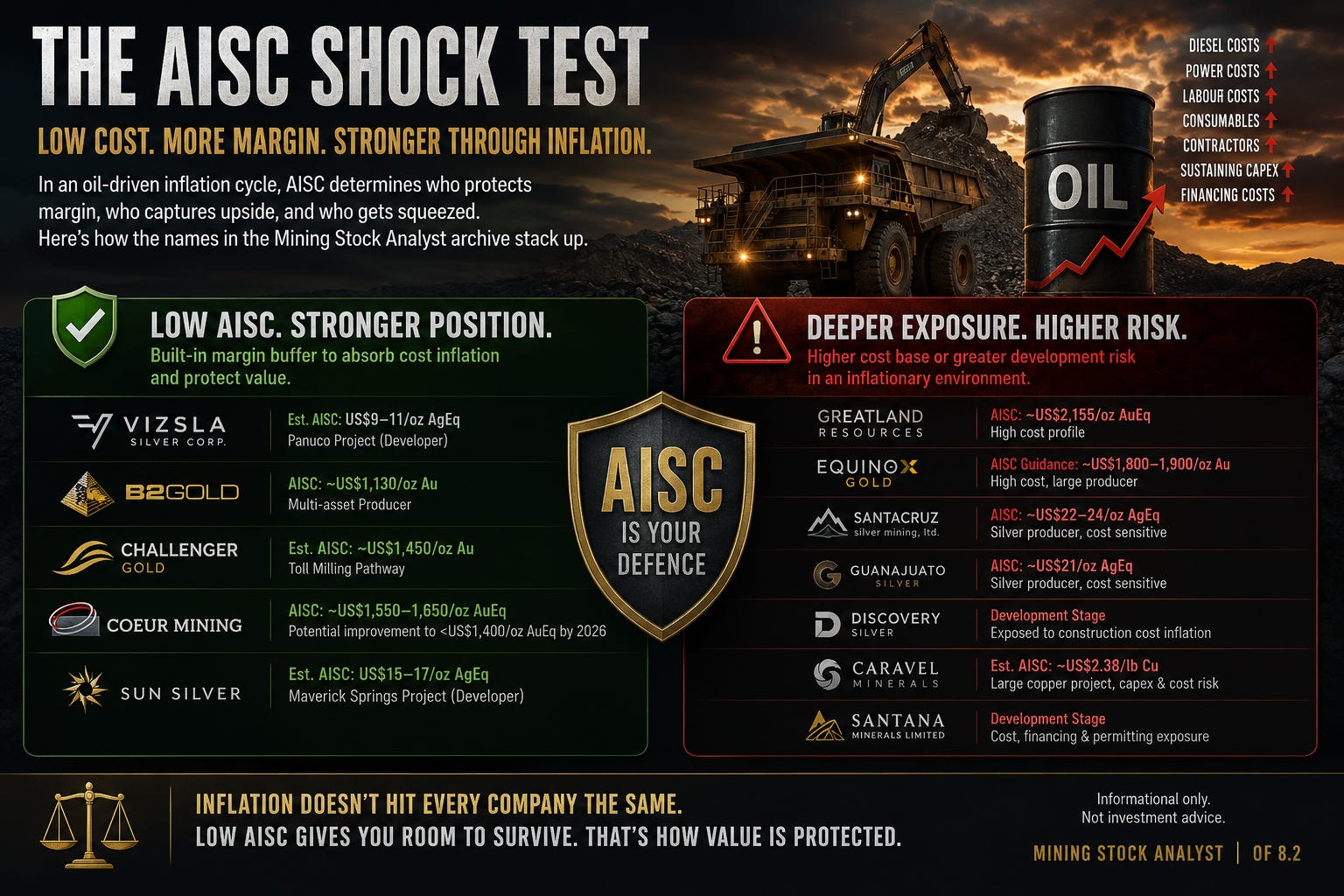
The following companies are drawn from the Mining Stock Analyst archive. The figures are archive-based reference points, not live guidance.
The low-AISC names that deserve the closest attention
Vizsla Silver stands out as one of the clearest low-cost candidates in the archive. The archive placed Vizsla’s estimated AISC at approximately US$9–11 per ounce silver-equivalent for Panuco. Source: Substack Research Archive (2019–2026).
That is a powerful starting point in an inflationary precious-metals cycle. If silver rises while diesel, labour, power, and consumables also rise, the companies with the lowest starting AISC have the most room to preserve margin. Vizsla’s appeal is therefore straightforward: if the estimated cost structure holds, Panuco could retain strong margin even after a meaningful inflation shock.
The risk is that Vizsla remains a developer. Its estimated AISC still has to survive updated capex, construction inflation, Mexican operating conditions, underground development assumptions, financing costs, and future dilution. It is not the lowest-risk name in the group. It is the strongest low-AISC silver candidate in the archive on estimated cost profile.
B2Gold offers a different kind of strength. The archive identified B2Gold’s AISC at approximately US$1,130 per ounce gold. Source: Substack Research Archive (2019–2026).
That matters because producer AISC carries more weight than study-stage assumptions. B2Gold is not trying to prove that a future mine can work. It already has operating assets, procurement scale, technical depth, and a cost base that can be measured against actual performance.
In an oil-driven inflation cycle, scale matters. Larger producers generally have better purchasing power, stronger technical teams, broader access to capital, and more flexibility to manage cost shocks than single-asset juniors. B2Gold is still exposed to fuel, power, labour, consumables, sustaining capex, and jurisdictional operating risk, but its low reported AISC gives it a stronger first line of defence than higher-cost producers or developers without operating data.
Challenger Gold sits between those two categories. The archive cited estimated AISC of approximately US$1,450 per ounce gold for its toll-milling pathway. Source: Substack Research Archive (2019–2026).
The attraction is not only the estimated AISC. It is the possibility of a less capital-intensive route to cash flow. In an oil-driven inflation cycle, avoiding a large greenfield build can matter. Full-scale construction exposes a company to steel, concrete, labour, power infrastructure, freight, camp costs, EPC pricing, equipment, contingency, working capital, debt terms, and equity dilution. A toll-milling pathway may reduce some of that pressure if access, terms, grade control, haulage, and operating execution are favourable.
That does not make Challenger immune to inflation. Toll milling still carries risk around haulage, mining rates, contractor costs, grade reconciliation, dilution, processing terms, and working capital. But the model may offer a more flexible response to inflation than a large new-build development, which makes Challenger an important low-AISC candidate in the archive.
Coeur Mining is a different case again. The archive identified a reported AISC profile of approximately US$1,550–1,650 per ounce gold-equivalent pre-merger, with potential improvement below US$1,400 per ounce gold-equivalent by 2026 if synergies and by-product credits are delivered. Source: Substack Research Archive (2019–2026).
Coeur is not necessarily the lowest-cost name on current reported figures, but it has a possible pathway where operating improvements and by-product credits could help offset cost inflation. By-product credits matter in an inflationary cycle. If silver and base metals perform alongside gold, multi-metal revenue can help protect margins. That does not eliminate AISC pressure, but it can soften the impact compared with a single-metal operation where costs rise and revenue depends on one commodity alone.
The market will need evidence. Expected cost improvement is not the same as delivered cost improvement. Synergies, operating discipline, sustaining-capex control, and by-product revenue must show up in reported numbers before Coeur can be treated as a clean low-cost winner. For now, it belongs in the group because it has producer status and a plausible cost-improvement pathway.
Sun Silver completes the low-AISC group. The archive estimated AISC at approximately US$15–17 per ounce silver-equivalent for Maverick Springs. Source: Substack Research Archive (2019–2026).
That gives Sun Silver a meaningful estimated margin buffer if silver strengthens during an inflationary cycle. Like Vizsla, it offers the possibility of strong silver leverage with a cost base that could remain attractive even after applying inflation pressure.
But the same caution applies. Sun Silver remains a development-stage candidate. Estimated AISC needs validation through updated studies, capex discipline, financing assumptions, permitting progress, and future operating execution. Its appeal comes from the estimated cost profile, not from proven production.
The names where inflation pressure matters most
The other side of the low-AISC screen is just as important.
Some companies will feel oil-driven inflation more deeply because their starting cost base is already high, their margin buffer is thin, or their economics depend on construction and financing assumptions that may no longer be conservative enough.
That does not make them automatic failures. Some may still offer strong upside if metal prices rise fast enough or management delivers a cost reset. But they are not defensive inflation candidates. They are the names where the AISC Shock Test matters most.
Greatland Resources is the clearest high-cost example from the archive. The archive cited AISC of approximately US$2,155 per ounce gold-equivalent. Source: Substack Research Archive (2019–2026).
At that level, the margin buffer is materially thinner than for lower-AISC gold producers. If diesel, power, labour, freight, contractors, consumables, and sustaining capital rise further, Greatland needs a strong gold price simply to preserve the valuation case. It may still have strategic appeal and asset quality, but under this framework it does not screen as inflation-resilient. It screens as a company where cost pressure sits near the centre of the risk case.
Equinox Gold is also important, but for a slightly different reason. The archive cited AISC guidance of approximately US$1,800–1,900 per ounce gold. Source: Substack Research Archive (2019–2026).
Scale gives Equinox some advantages. Larger producers can have better capital-market access, more procurement leverage, and a broader asset base than single-mine operators. But scale does not erase high AISC. If oil-driven inflation pushes costs higher, a producer already operating at elevated AISC has less room before margin compression becomes material. Equinox can still benefit if gold rises strongly, but it should be viewed as a leveraged gold-price name rather than an inflation-defensive name.
The same logic applies in silver. Santacruz Silver provides useful producer cost exposure, but the archive cited consolidated AISC around US$22–24 per ounce silver-equivalent. Source: Substack Research Archive (2019–2026). Guanajuato Silver was cited at approximately US$21 per ounce silver-equivalent. Source: Substack Research Archive (2019–2026).
Those cost levels can work in a strong silver market, but they are not low enough to be treated as defensive. These companies need silver to rise faster than diesel, power, reagents, labour, contractors, sustaining capital, and local operating costs. If silver breaks higher, the leverage can be significant. If costs rise at the same time, the realised margin improvement may be smaller than investors expect.
Discovery Silver, Caravel Minerals, and Santana Minerals face a different form of inflation risk. They are not exposed in the same way as high-AISC producers. Their greater risk is development-stage inflation.
For Discovery, the issue is construction inflation. Large undeveloped silver projects can look attractive on paper, but oil shocks do not only raise future operating costs. They raise construction costs, equipment costs, contractor pricing, freight, camp costs, working capital, financing costs, and potential dilution. In that environment, the market will wait for proof that the construction budget still holds.
Caravel Minerals has copper relevance, but large copper projects are especially exposed to the very inputs most vulnerable in an oil-driven inflation cycle: fuel, power, earthmoving, construction labour, steel, grinding media, reagents, equipment, contractors, water infrastructure, tailings infrastructure, debt terms, and permitting timelines. The archive cited a peer-derived AISC estimate of approximately US$2.38 per pound copper. Source: Substack Research Archive (2019–2026). Copper may remain strategically important, but Caravel should not be treated as an inflation shelter. It is a capex- and operating-cost stress-test candidate.
Santana Minerals remains one of the more interesting gold development names in the archive, but it also belongs in the exposed category for this article. The issue is not only AISC. It is the combination of development-stage risk, New Zealand inflation, expected RBNZ tightening, permitting scrutiny, and future project financing. A developer facing rising local costs and higher interest-rate expectations can feel pressure before mining begins, through labour, contractors, fuel, power, transport, owner’s costs, contingency, debt pricing, and dilution.
Santana may still have high-quality gold exposure. But under the AISC Shock Test, it needs clearer cost and financing assumptions before it can be considered inflation-resilient.
What this means for investors
The point is not that one group is guaranteed to win and the other is guaranteed to fail.
The point is that they should be treated differently.
A low reported AISC is a defensive signal. It does not remove risk, but it gives a company room to absorb cost pressure before margins are damaged.
A low estimated AISC is an upside signal. It can identify a future margin leader, but only if the estimate survives updated capex, financing, construction, and ramp-up realities.
A high or uncertain AISC is not fatal, but it demands a higher return threshold. If a company already sits high on the cost curve, the metal price has to do more work. If a developer needs large capex in an inflationary market, the construction budget has to be trusted. If a silver producer is already cost-sensitive, silver has to outrun the cost base.
That is the practical lesson from the archive.
Vizsla Silver, B2Gold, Challenger Gold, Coeur Mining, and Sun Silver are the low-AISC names that deserve the closest attention. They are not automatic winners, but they begin with a more attractive margin setup.
Greatland Resources, Equinox Gold, Santacruz Silver, Guanajuato Silver, Discovery Silver, Caravel Minerals, and Santana Minerals require harsher scrutiny. Some are exposed because AISC is already high. Some are exposed because operating leverage cuts both ways. Some are exposed because construction inflation can damage NAV before first production.
That distinction matters in an oil-driven inflation cycle.
Final takeaway
The inflation question facing mining investors is not whether costs are rising. They are.
The question is which companies have enough margin buffer to withstand the shock.
In this environment, low AISC becomes survival capital. It gives a company more room to absorb higher diesel, freight, labour, power, consumables, contractors, sustaining capex, and financing costs before NAV is impaired.
The best opportunities are not automatically the largest resources or the lowest headline NAV Ratios. They are the companies whose economics still work when the cost base is stressed.
On the Mining Stock Analyst archive numbers, the low-AISC names to watch most closely are Vizsla Silver, B2Gold, Challenger Gold, Coeur Mining, and Sun Silver.
The names most exposed to cost inflation are Greatland Resources, Equinox Gold, Santacruz Silver, Guanajuato Silver, Discovery Silver, Caravel Minerals, and Santana Minerals.
That does not make the first group automatic winners or the second group automatic failures. It means the market should treat them differently. Low-cost companies deserve attention because they have margin protection. Higher-cost or capex-heavy companies need stronger metal prices, better execution, or clearer cost control before the valuation case becomes compelling.
In this environment, cheap ounces are not enough.
The better question is simple:
Which ounces still make money when everything else costs more?
Informational only; not investment advice.

— Operational Flow 8.2 (OF 8.2)